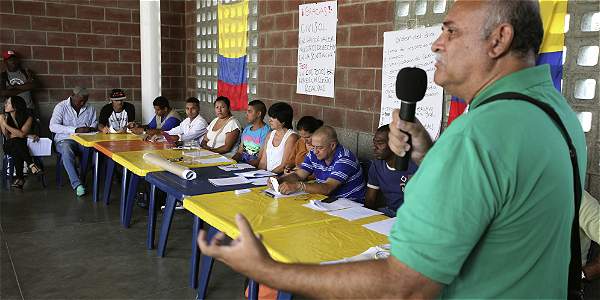
X085 El Tiempo / ARCA sigue luchando para representar a los recicladores en Cali
2015-02-22Arca sigue luchando para representar a los recicladores en Cali 2015, Bogotá, Redacción Periódico El Tiempo Asociados no comparten el que... Read More

X195 Razón Pública / Basuras: lo que no existe es el servicio público de aseo
2014-05-12Basuras: lo que no existe es el servicio público de aseo 2014, Bogotá, Razón Pública A diferencia y en contra del... Read More

X093 El Tiempo / Nace en Cali ‘Aire’, la empresa de los recicladores
2014-05-12Nace en Cali 'Aire', la empresa de los recicladores 2014, Bogotá, Redacción Periódico El Tiempo La presentación de la nueva firma... Read More
X099 EL TIEMPO Abril 26 Cali sigue con su deuda frente a los recicladores
2014-04-25Cali sigue con su deuda frente a los recicladores 2014, Cali, Redacción Periódico El Tiempo Mientras lío jurídico suspende licitación para... Read More
X213 RRA PUBLI FMI Ruiz-Restrepo recomendaciones
2014-01-01Recomendaciones de Adriana Ruiz Restrepo para la Regulación Tributaria de las Entidades Sin Ánimo de Lucro (ESAL) -Caso Colombia- 2014, Colombia,... Read More
X058 Constitutional Court of Colombia Supervisory Decision (Auto de Seguimiento) 268 / 10
2013-09-09Constitutional Court of Colombia Supervisory Decision (Auto de Seguimiento) 268 / 10 2013, New York, CIVISOL Original Unabridged Version. The summary... Read More
X231 T-724/03 Constitutional Writ of Human Rights Protection, ESCR-NET Caselaw Database
2013-08-20Constitutional Human Rights Ruling T-724/03 2013, New York, ESCR-Net, Caselaw Database Writ of Protection (Tutela) in a case argued by a... Read More

X201 Recicladores y Residuos: ese obscuro objeto
2013-05-06Recicladores y residuos: ese obscuro objeto del deseo 2013, Bogotá Razón, Pública Balance macondiano del reciclaje en Colombia: han ganado los... Read More
X228 T-291/09 Constitutional Writ of Human Rights Protection, ESCR-NET Caselaw Database
2013-04-05Colombian Constitutional Court T-291/09 2013, New York, ESCR - Net, Caselaw Database Tutela on labor rights. Amicus strategically presented to claim... Read More
[vc_row][vc_column][vc_column_text]
Constitutional Court of Colombia Ruling (Writ / Tutela) for Human Rights T-724/03
[/vc_column_text][vc_column_text]
2013, New York, CIVISOL
Original Unabridged Version. The summary published by ESCR-NET is available in http://bit.ly/2lom6OM
Request for a Writ of Human Rights Protection via Injunction (Tutela) filed by Silvio Ruiz Grisales and Nohra Padilla, against the City and Capital District of Bogota / Public Utilities Executive Unit (UESP) on December 23, 2002. Request denied in municipal court on February 20 and again in front of a circuit court on February 26. Also rejected was a request for review by the Constitutional Court. Finally with two petitions of insistence for review solicited, obtained and filed, the Constitutional Court agreed to select the case for review.
Country: Colombia
Thematic Focus: Poverty, Informal Economy, Privatization, Public Domiciliary Utilities, Tenders, Public Procurement, Equality/Nondiscrimination, Realizing ESCR of vulnerable population, Affirmative Action, Obligation to adopt special protective measures, Special treatment of disadvantaged groups, Progressive realization/non-retrogression
Forum and Date of Decision: First Revision Courtroom of the Constitutional Court of Colombia, August 20, 2003
Nature of the Case: Request for a Writ of Human Rights Protection via Injunction (Tutela) filed by Silvio Ruiz Grisales waste picker and Nohra Padilla waste picker and legal representative of the Association of Waste Pickers of Bogota (Asociacion de Recicladores de Bogota-ARB), one of Bogota´s Federations of waste pickers organizations, seeking the inclusion of informal, poor, traditional waste pickers’ cooperatives and in the Waste Management Privatization Process of Bogota. Filed against the City and Capital District of Bogota / Public Utilities Executive Unit (UESP) regarding their rights to equality, due process, good faith, right to life or survival, right to a Minimum Subsistence Level (mínimo vital) and work.
Summary: Based on articles 49, 365 to 370 of the Constitution; Law 142/1994 or the Public Domiciliary Utilities Act which allowed for cities to privatize the municipal solid waste management; Decree 1713 of 2002 which established that the collection, transport and elimination of household waste was to be divided into two separate routes: one to transport organic refuse to the Doña Juana landfill and a new second selective route of inorganic refuse or recyclables for elimination by the public classification for valorization or inorganic waste to commercialize as secondary commodities to the plastic, metal, glass and paper and cardboard industries, and following the recent liquidation of the local public waste company (EDIS), the District of Bogota, Executive Unit of Public Services (currently the Special Administrative Unit of Public Services-UAESP) drafted Terms of Reference for procuring Municipal Solid Waste Management services on behalf of the State as concessionaires of the public service of city cleanliness and sanitation or public hygiene. The international tender was opened to adjudicate six contracts within each of the six Areas of Exclusive Service- ASEs - into which Bogota had been zoned, with exclusivity for 7 years.
With the formalization of a public waste collection route for recyclables in Bogota, waste pickers would lose access to the household, commercial and industrial waste they had based their living and livelihood on. Although trying to participate in the precontractual phase and even in the tender, they could not do it effectively. The bidding documents were expensive to buy, the Terms of Reference incorporated narrow admissibility requirements to compete for the public contracts (e.g., time, extent and type of experience) and the only inclusion materialized was not as an occupational group in poverty and informally working in waste but merely as part of vulnerable population and alongside internally displaced population. The tender only foresaw that 15% of employees in grass trimming were to be sourced from idps and waste pickers. The waste pickers as a traditional and occupational group of individual or cooperative own account workers were de jure and de facto excluded by the State even from the possibility of formalizing into a waste economy, and even though public procurement was their last remaining opportunity to be included and have formal access to waste. It was requested that the public tender process be suspended and amended so to include an affirmative action for the waste pickers’ positive discrimination in public procurement for waste-related tenders to secure their right to equal treatment under the law and to enjoy a vital minimum in connection to their right to work in their customary trade of waste collection and classification as no regulatory or statutory provision secured their constitutional rights. The municipal court denied that the UAESP need take positive steps to protect the recyclers or that such measures would outweigh the Unit’s decision regarding the suitability of those who provide public services to Bogota. The circuit court affirmed this decision.
Once the case went under review of the Constitutional Court, T-724-03 affirmed that article 13.2 of the Colombian Constitution requires that the state promote conditions of real, effective and material equality in favor of discriminated or marginalized groups. Thus, in not adopting special measures to protect the recyclers, a vulnerable and marginalized population, the UAESP violated article 13 of the Constitution. It is to be noted that just before the Court ruling came out, the privatization tender was closed and the UESP adjudicated the 6 contracts as planned; hence the tutela was rendered moot at the moment of the ruling; however the Court agreed to create the affirmative action and projected it to future waste procurement – ordering the UAESP to include measures favorable to the waste pickers in future bidding processes for public services. It also exhorted the District council (Concejo de Bogota) to take appropriate measures of inclusions in the meantime.
Enforcement of the Decision and other Outcomes:
Note: Arguments for change and protection granted by the Court has been refined and developed by subsequent constitutional decisions C-741-03 and T-291-09 and its orders supervised by Auto 268-10 and Auto 275-11.
T-724 could not timely guarantee the inclusion of waste pickers in waste public contracting and the City of Bogota never built the public sanitation infrastructure necessary to support their inclusion as ordered by Decree 1713 of 2002, i.e., a place where to transfer and stockpile all collected recyclables and then transport them as required for public classification in public separation plant in the outskirts of the city to the proceed to commercialization for industrial recycling as a form of waste elimination. The City did implement a small pilot project for waste classification – La Alqueria – and granted its operation to the ARB petitioners, where the concessionaries transported and discharged their formal weekly selective route of inorganic refuse barely half filled as the 8000 informal and urban waste collectors of Bogota continued to collect, transport, classify and sell for subsistence income the handpicked recyclables to multinational and national industries intermediating the market through antennae warehouses across the city.
Bogota´s town hall (Concejo de Bogota) issued the Acuerdo 287 on June 28, 2007 around the need of waste pickers’ affirmative action for inclusion in Municipal Solid Waste Management.
Thousands of million pesos have been given away through nonprofit direct contracting to NGOs “assisting on the implementation of affirmative action” by way of mostly innocuous courses, forums, workshops and brochures.
However, this case legally empowered the waste pickers of Bogota in 2003 as represented by the ARB and also provided a social axis to further pivot, cohere and project the Colombian waste pickers’ social movement in Colombia and within Latin America. Waste pickers grassroots organization and federation had been progressively advancing since the mid-eighties by the initiative and support of Fundacion Social in Colombia, and was so until mid-nineties. Teaming for system change in law and societal culture began with this case. Using law for poverty reduction also attracted international attention to their waste pickers case and struggle in 2008 and later on attracted international administrative and economic support to the ARB as the oldest organization in the national movement.
Attorneys’ involvement: Adriana Ruiz-Restrepo (ad honorem)
Source: http://bit.ly/2lLLxdZ
[/vc_column_text][/vc_column][/vc_row]
X055 Constitutional Court of Colombia Ruling (Abstract Control) C-741/03
2013-01-01Constitutional Court of Colombia Ruling (Abstract Control) C-741/03 2013, CIUDAD?, Shailly Barnes for CIVISOL Original Unabridged Version. The summary published by... Read More
X057 Constitutional Court of Colombia Ruling (Writ/Tutela) for Human Rights Protection T-291/09
2013-01-01Constitutional Court of Colombia Ruling (Writ/Tutela) for Human Rights Protection T-291/09 2013, New York, CIVISOL Original Unabridged Version. The summary published... Read More
X054 Constitutional Court of Colombia / Supervisory Decision (Auto de Seguimiento) 275 / 11
2013-01-01Constitutional Court of Colombia / Supervisory Decisión (Auto de Seguimiento) 275 / 11 2013, New York, CIVISOL Original Unabridged Version. The... Read More

X219 SEMANA SOSTENIBLE / Basura Cero
2012-11-20Cerca de 50.000 familias en Colombia viven del reciclaje. El trato que ellas han recibido en Bogotá y Cali ha motivado que la Corte Constitucional se pronuncie y ordene a los gobiernos locales crear modelos inclusivos de recolección de basura.
Read MoreX197 Razón Publica / La industria del aseo: higiene pública, materia prima, inclusión social y fortín electoral
2012-09-24La industria del aseo: higiene pública, materia prima, inclusión social y fortín electoral 2012, Bogotá, Razón Pública La historia de la... Read More
X078 EL PAIS Una nueva organización fomentará el trabajo en las comunidades
2011-12-21Una nueva organización fomentará el trabajo en las comunidades 2011, Bogotá, Periódico El País Organizaciones Solidarias jugará un papel especial en... Read More
X091 EL TIEMPO / La Corte Constitucional deja sin efecto licitación del aseo en Bogotá
2011-12-19La Corte Constitucional deja sin efecto licitación del aseo en Bogotá 2011, Bogotá, Redacción Periódico El Tiempo Según el alto tribunal,... Read More
X089 El Tiempo / Fracasa tercera tutela contra megalicitación de aseo en Bogotá
2011-08-11Fracasa tercera tutela contra megalicitación de aseo en Bogotá 2011, Bogotá, Redacción Periódico El Tiempo Recicladores interpusieron una tutela contra la... Read More

X207 Revista Semana / Conejo a recicladores
2011-03-25Conejo a Recicladores 2011, Bogotá, Revista Semana Hace dos años la Corte Constitucional falló una tutela en favor de los recicladores... Read More
X087 El Tiempo / CUMPLIMIENTO DE SENTENCIA DE CORTE CONSTITUCIONAL, AÚN EN VEREMOS
2010-03-27Cumplimiento de Sentencia de Corte Constitucional, aún en veremos 2010, Bogotá, Redacción Periódico El Tiempo Recicladores siguen en el limbo Los... Read More